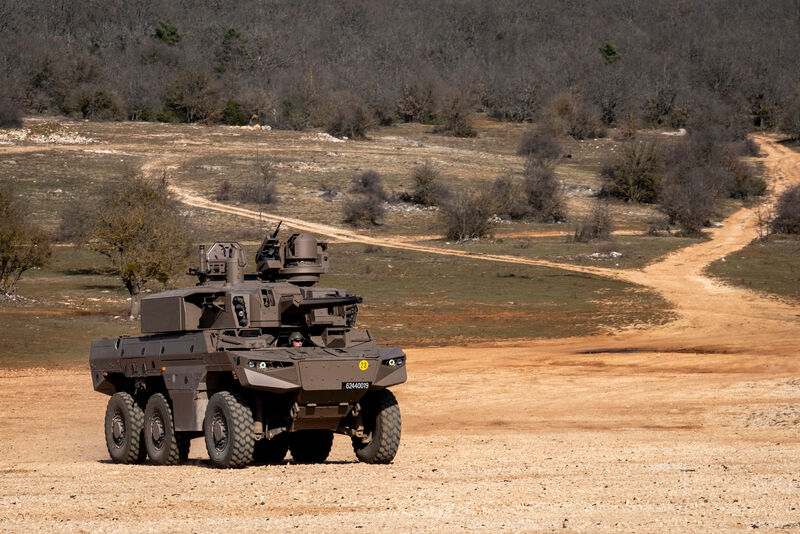
Changes are under way in the ground forces, in terms of their modernisation and the adaptation of their capabilities to the current and most probable future commitments on a 15-year timeframe. These required changes are aimed at creating ground forces with a more compact, multirole architecture, and with an integrated logistic element. With more powerful and controlled offensive capabilities, based on combinations adapted to each engagement, they will have better protection and improved tactical mobility, particularly with the NH90. And with digital information systems down to the lowest tactical level they will have greater operational effectiveness in a context that is constantly changing, and which demands permanent flexibility and the ability to change direction.
Evolution in Ground Forces: Meeting the Challenges
The Army project, a huge undertaking, is both a long-term objective (on the 2020-25 horizon) and a process of adaptation of its capabilities from the present basis, and within a joint service environment, in the face of current and most probable future commitments. It takes into account the new geostrategic factors, new threats and the economic and social constraints that face the international community, and it incorporates the main technological developments (miniaturisation, digitisation and propulsion) and developments in operational techniques (the importance of built-up areas, of populations, and of the stabilisation phase). It takes into account the complexities of environmental factors, of support for tactical manoeuvre, particularly the aspects of logistics and operational intelligence.
A Context that Conditions Developments in Military
Capabilities
The likelihood of a traditional war involving industrialised nations on a roughly equal footing is fading. In an ever more interconnected global system, the resources that would be required and the horrendous destruction that it would imply, as much for the victor as for the vanquished, would exhaust the protagonists and create unacceptable disaster beyond any possible war aims. Moreover, nuclear deterrence continues to play a fundamental role in lowering the level of classic conflict. Nonetheless, this reasoned observation does not eliminate the spectre of asymmetrical conflict, and the dormant state of traditional warfare does not mean that a nation should abandon any capability to conduct it.
The nature of current confrontations (force projection, emergency intervention, prolonged stabilisation phases and bogging down in regional problems) indicates the need to take a different approach to achieving military solutions. Traditional large-scale confrontation (power projection, heavily supported armoured and mechanised concentrations) are giving way to operations where it is more important to dissuade, to supervise, to control a milieu and its population over a long period, rather than concentrate on the overall, methodical destruction of the adversary, military or otherwise. Such operations will be characterised by grasping and exploiting fleeting tactical opportunities in a highly insecure environment. To win, we have to know how to create conditions favourable to a return to lasting peace, in a complex and changing milieu.
Il reste 83 % de l'article à lire