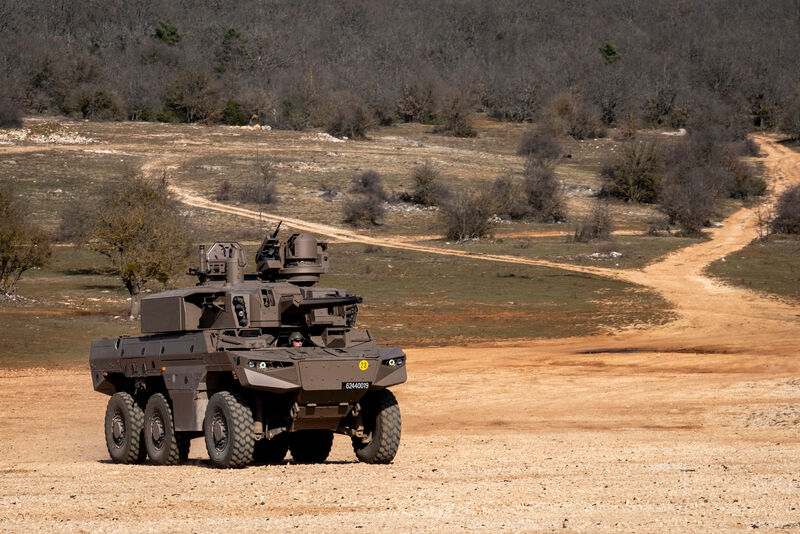
Infantry remains, more than ever, at the core of the armed forces’ action doctrine. However, it needs equipment and systems that are compatible with its missions. This is exactly what is provided by Nexter Systems, with the VBCI, a wheeled armoured infantry combat vehicle designed and developed in close cooperation with the men who’ll use it operationally.
The VBCI at the Heart of Infantry Action
In spite of all the scenarios that were thought up during and after the Cold War, the infantry remains a central element of any consistent forces engagement doctrine. Lessons learned from recent engagements, from Iraq to Côte d’Ivoire, and including Afghanistan and the Democratic Republic of the Congo, confirm that land forces’ missions have become more diversified, and are tending towards targeted environment control actions that are reversible and limited in their use of force but can be significantly reinforced if necessary. In fact, the Leclerc main battle tank may paradoxically appear as a support for infantry action, for example in Lebanon, rather than the reverse.
Approach, Contact and Control
More than ever, the infantry’s role is still close combat on foot. For this, it needs suitable equipment for both the approach and contact phases and, subsequently, for the target zone ongoing control phase. The FELIN(1) soldier meets some of these requirements. As a complement, the VBCI is the appropriate response to many requirements covering the zone approach and control phases, and also the actual contact.
The preliminary operations preceding infantry combat frequently involve airlifted projection followed by an armoured operation, both of which meet the increasing requirement for strategic, operational and tactical mobility. The first element of this requirement is notably the objective of the BOA (Air/land Operational Bubble), and the VBCI meets the requirement by being airtransportable by the future A400M.
Il reste 91 % de l'article à lire