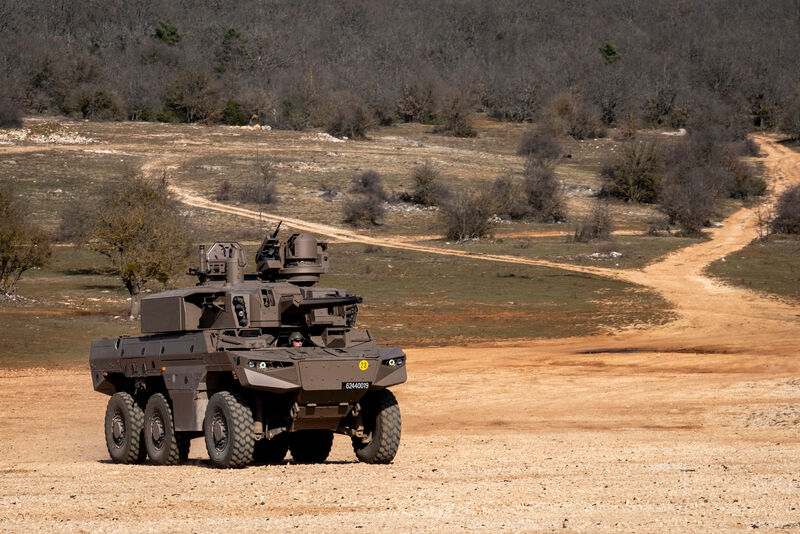
The search for optimisation of the capabilities of forces in contact, which are faced with rapid changes in the threat, techniques and the management of resources, has led to a ‘system of systems’ approach. For the French Army, the Scorpion project adopts such an approach, exploiting material advances in a measured way for the benefit of the combatant.
Scorpion: Mastery of the Contact Battle
Three of the factors influencing the preparation and use of armed force are changing rapidly at the beginning of the twenty-first century: the threat, the techniques and the management of resources. This context leads to corresponding changes in the forces. For the land forces, this requirement for change leads in turn to a quest for the optimisation of the capabilities of the battlegroup (BG), a true operational system and the building block of the airland force. It is this with which the Scorpion project is concerned.
Scorpion aims at providing the commander of an operation with integrated combat forces, flexible and adaptable up to battalion level, capable of overcoming an adversary, among a population, over the full spectrum of operations. There is nothing revolutionary in this. The constituent elements of contact which have emerged from centuries of armed conflict are still pertinent. It is necessary to fight on foot to seize strongpoints and to hold ground for lengthy periods. It is necessary to manoeuvre, with ever-increasing speed, to create a locally superior force ratio and to disorganise the enemy with shock action. It is also necessary to strike opportunity targets in all weathers to neutralise, delay and demoralise the enemy. And it is necessary to ensure the mobility of our forces and degrade that of the enemy.
But all this must be done in the context of the ‘three main phases of a continuum [which] characterise the engagement of forces in an armed conflict: intervention, stabilisation and normalisation [and all of which] include, in different and variable proportions, periods of coercion, the use of violence and of high and low intensity.’(1)
Il reste 90 % de l'article à lire