The aim of the Heeresinstandsetzungslogistik (HIL), a German publicprivate partnership, is to relieve the Bundeswehr of logistic tasks that can be carried out more economically by industry.
Cooperation with German Army Maintenance Logistics (HIL): First Year of Full Routine Operation
HIL (Army Maintenance Logistics) is a cooperation agreement with German industry which is based on the Framework Contract on ‘Innovation, Investment and Economic Efficiency in the Bundeswehr’ concluded between the Federal Government and representatives of German industry on 15 December 1999. The overriding aim of this framework contract is to relieve the Bundeswehr of tasks that need not necessarily be performed by the armed forces and can be carried out more economically by industry.
With the establishment of the HIL GmbH (Army Maintenance Logistics Company Ltd) in February 2005, a cooperation company was created by the Federal Government with a qualified 49 per cent minority holding and HIL Industrie-Holding GmbH with a 51 per cent holding, in which the Industriewerke Saar (IWS)—a firm of the VA Systeme subgroup of DIEHL Stiftung und Co.—Rheinmetall Landsysteme (RLS) and Krauss-Maffei Wegmann (KMW) have equal shares. As system houses and long-standing Bundeswehr partners in the maintenance of the primary weapon systems, these firms contribute their industrial know-how and experience to the cooperation. The HIL GmbH is a service enterprise organised as a private company and controlled by HIL Industrie-Holding GmbH. The company is managed by one industry representative in the areas of finance and enterprise development and by one armed forces' representative in the rank of brigadier-general in the areas of technology and logistics.
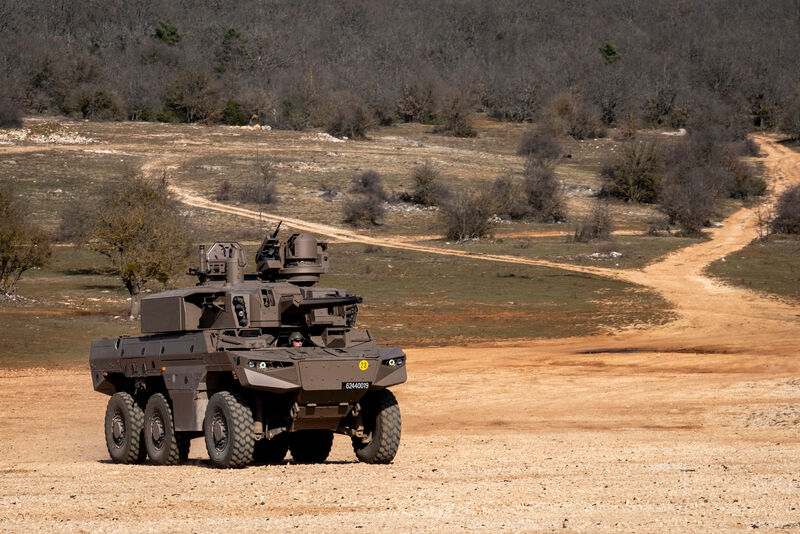
The mission of the HIL GmbH is to plan, control and perform maintenance work on major equipment under the single manager responsibility of the Chief of Staff, German Army. These largely armoured weapon systems are in the following subsumed under the term ‘HIL equipment’. Depending on available capacity, the HIL GmbH additionally repairs other equipment such as soft-skinned wheeled vehicles or weapons. The central idea of this concept is to guarantee an unlimited availability of 70 per cent of the HIL equipment on working days. This approach is similar to the mobility guarantee provided for passenger vehicles by the contract repair shops. To provide its services, the HIL GmbH has established a nationwide organisation. It consists of the headquarters in Bonn, three shops for complex maintenance work as well as a network of eight branches with currently 56 bases (including sub-offices) to support the routine duty on location. The organisation of the HIL GmbH follows the logistic requirements and is continuously adapted to the structural changes in the Bundeswehr. As part of the performance contract, the HIL GmbH has committed itself to integrate the available civilian maintenance capacities and Bundeswehr command personnel into the provision of services. This led to an organisation structure with personnel recruited from industry and military personnel on leave, assigned civilian wage-grade employees, salaried public employees and civil servants as well as soldiers serving in assignments according to a specific assignment pattern. At the end of the migration phase in late 2006, the HIL GmbH had a total of approximately 2,200 male and female personnel.
Il reste 74 % de l'article à lire