Enjeux et défis de la géopolitique de l’Indo-Pacifique en océan Indien
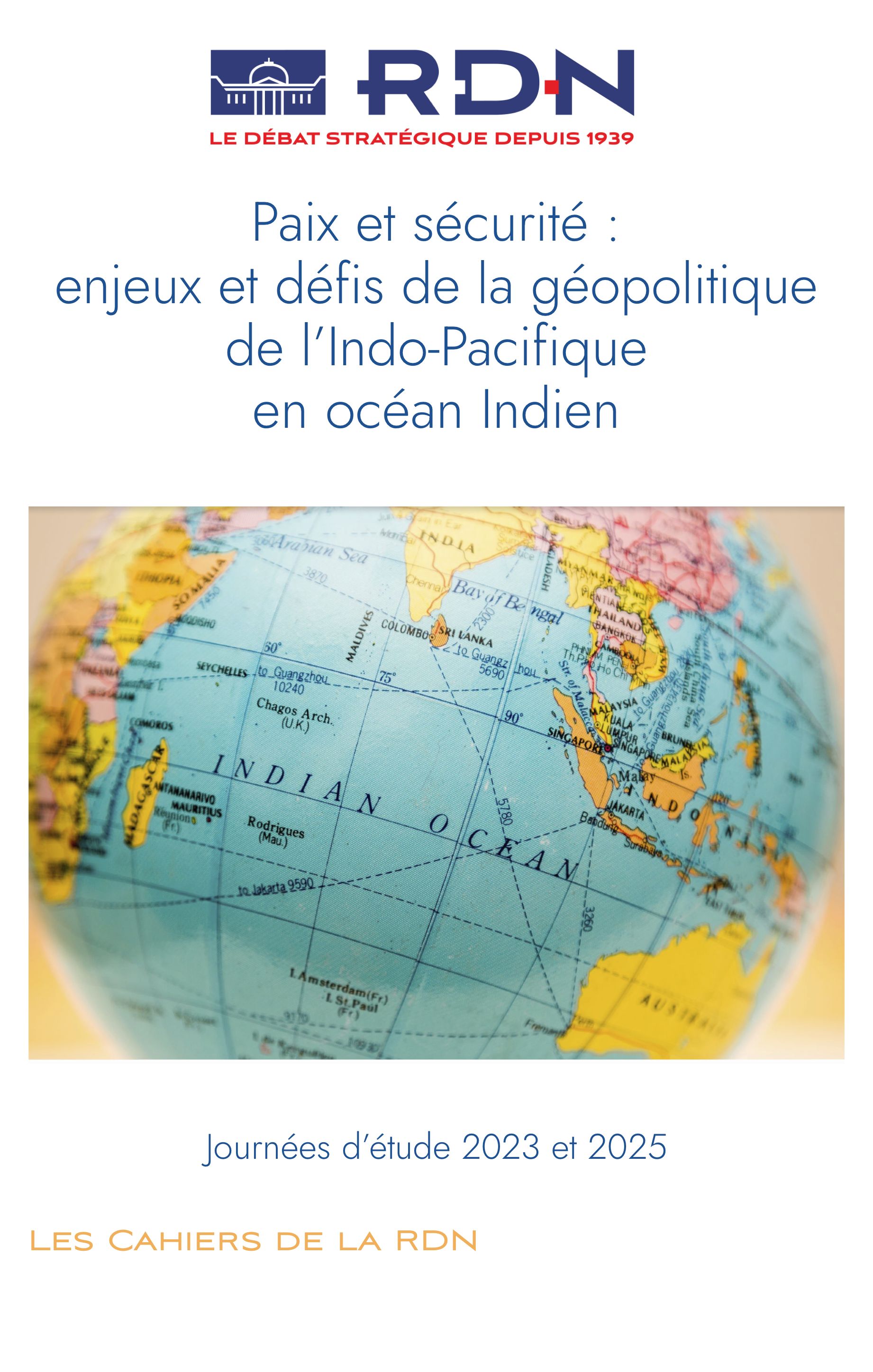
Ce Cahier de la RDN constitue un florilège des réflexions et regards croisés des deux premières éditions des journées d’étude indo-pacifiques organisées à l’Université de La Réunion en décembre 2023 et février 2025.
Ce Cahier de la RDN constitue un florilège des réflexions et regards croisés des deux premières éditions des journées d’étude indo-pacifiques organisées à l’Université de La Réunion en décembre 2023 et février 2025. Le 13 et le 14 décembre 2023, l’association régionale des auditeurs de l’Institut des hautes études de défense nationale (IHEDN) de l’océan Indien a organisé pour la première fois un forum « Paix et sécurité » de deux journées à l’Université de La Réunion consacré à la réflexion des grands enjeux de la géopolitique indo-pacifique. Lire la suite
Visions géopolitiques indopacifique, indianocéanique et australienne
Merci aux organisateurs de ces Journées d’études. La pertinence des thématiques abordées, comme l’excellence des intervenants et des participants, témoigne d’une volonté commune de faire de cet événement un moment clé pour l’avenir de notre région. C’est un honneur pour la Commission de l’océan Indien d’être partenaire de cette initiative, et je tiens à saluer l’engagement de l’Union européenne (UE), via le programme Safe Seas Africa, qui a permis la participation de représentants des États-membres et partenaires de la Commission de l’océan Indien (COI). Lire la suite
Australia and France have both been at the forefront in adopting the Indo-Pacific as their conceptual frame of reference in understanding this region, although they have approached the idea from somewhat different angles, reflecting their different history and geographies. Both countries share underlying concerns about China’s hegemonic ambitions as well as concerns about a series of transnational security threats that could threaten the security and stability of smaller countries in the Indo-Pacific. This creates many imperatives for the two countries to work together and with others as Indo-Pacific partners. Key potential initiatives include areas such as maritime security (particularly in Intelligence, surveillance and reconnaissance), environmental security and good ocean governance. Lire la suite
L’Indo-Pacifique est souvent analysé depuis l’Asie ou le Pacifique ; notre approche est sur et depuis l’océan Indien. « La région de l’océan Indien sera le véritable lien entre la puissance mondiale et le conflit dans les années à venir. C’est ici que la lutte pour la démocratie, l’indépendance énergétique et la liberté religieuse sera perdue ou gagnée. (1) » Cela apporte une contextualisation originale et actualisée de la géopolitique de l’Indo-Pacifique ; cela renouvelle la vision stratégique. Lire la suite
French has been taught in Australia since the late nineteenth century, making it the first foreign language formally introduced into the national education system. This early adoption was closely tied to Australia’s British colonial heritage, as many settlers—particularly Scottish—had studied French in Britain and sought to continue the tradition in the colony. For decades, French occupied a privileged place in schools and universities, reflecting Australia’s cultural and political alignment with Europe and North America rather than with its immediate neighbours in Asia and the Pacific (Clyne, 2005; Ritchie, 2003). Lire la suite
Approches croisées des enjeux de sécurité et défense indo-pacifiques
US Policy in the Indian Ocean Region - Richard Fontaine - p. 31-35
Setting foreign policy priorities is always one of the most challenging tasks that U.S. government officials face. In today’s competitive geopolitical climate, with crises heating up across the world, the difficulty of choosing which areas and issues matter most is greater than ever. Despite the Trump administration’s initial desire to avoid foreign entanglements and to focus its energy on domestic issues, the reality is that the United States remains a great and global power, with interests and commitments in many places. Rather than forgoing any engagement abroad, Washington is instead confronted with the task of choosing where and how best to allocate its limited resources and attention. Lire la suite
Why does Japan need the QUAD? An important feature of Japan’s current strategic policy is its concept of the Quadrilateral Security Dialogue (QUAD) in the Indo-Pacific. Japan was a pioneer in creating the concept of both the Indo-Pacific and the QUAD. It was related with the security for Japan. Lire la suite
For many years, Australia largely neglected the Indian Ocean as the second of three oceans that surround the Australian continent. For many decades Australia focused on its neighbours in the Pacific and East Asia as key economic and security partners. Australia has a long history of being an active middle power in terms of organising and securing its region and it has long been a leading player in the Pacific and Southeast Asia. Lire la suite
How can small states with an interest in maritime security develop a posture in the Indo-Pacific that is not only strategic, but also sustainable in the current security landscape? With recent anti-global tendencies and the (re)turn to geopolitics in foreign policy, the maritime domain plays a significant role in facilitating power projection. This is seen in the Indo-Pacific. Its constituent seas, the Indian Ocean and Pacific Ocean, are bordered by countries with economic, military and cultural importance, and the region’s maritime supply chains are vital for global trade. Yet the Indo-Pacific is experiencing increased hardening of threats and diversification of tension at sea. The high seas – as opposed to sovereign territories on land – are “neutral” spaces; they are international, belong to us all and are not the territory of any state. This makes it possible to create strong political, economic and cultural messaging to the world through violent means without infringing a state’s sovereignty and territorial integrity – but with threats to the freedom of navigation enshrined in the UN Convention on the Law of the Sea (UNCLOS 1982). Lire la suite
Germany’s relationship with the Indo-Pacific is a multilayered story of colonial ambition, Cold-War division, economic interdependence, and twenty-first-century strategic recalibration. The nation’s past encounters continue to inform present policy, even as Germany confronts intensified Sino-American rivalry, shifting regional alliances, and the imperative to secure maritime supply routes. This paper will look at Germany’s engagement with the Indo-Pacific from past to present in an overview. Lire la suite
La coopération en matière d’aide humanitaire et de secours en cas de catastrophes (Humanitarian Assistance and Disaster Relief – HADR) est un thème d’importance croissante dans les relations internationales contemporaines. Les catastrophes naturelles se multiplient sur la planète, liées principalement, mais pas exclusivement, au changement climatique, appelant partout des réponses collectives. Paradoxalement cependant, parler du rôle croissant de l’HADR dans la coopération internationale, c’est d’abord parler de l’importance croissante de l’HADR comme instrument de compétition internationale. Dans un contexte de rivalité croissante entre grandes puissances, le caractère coopératif de l’HADR est de plus en plus influencé par des considérations géopolitiques. L’HADR est devenue, depuis le début du siècle, un instrument majeur dans la lutte d’influence entre puissances et de fait, de plus en plus compétitive. Bien que de manière inégale selon les régions, elle se transforme progressivement en un jeu à somme nulle. Lire la suite
Depuis le début des années 2000, l’Indo-Pacifique s’affirme comme le centre de gravité des recompositions stratégiques mondiales. Cette région, vaste et ouverte, concentre des enjeux économiques, politiques et militaires majeurs, qui dépassent largement l’échelle régionale. La montée en puissance de la Chine et son affirmation en mer de Chine méridionale, le renforcement des capacités nucléaires et conventionnelles de la Corée du Nord, ou encore la projection croissante des forces russes, inscrivent la région au cœur des préoccupations stratégiques. Si l’Europe focalise son attention sur les crises de sa façade orientale et du Moyen-Orient en raison de leur proximité géographique et du risque d’escalade, elle ne peut pour autant ignorer les dynamiques à l’œuvre en Indo-Pacifique. En tant que levier de projection de puissance et moteur de coopération avec nos partenaires de la région, l’Armée de l’air et de l’Espace (AAE) y joue désormais un rôle clé sur lequel cet article se propose de revenir. Lire la suite



.jpg)